









Authority / Editorial

What Is a
Load-Bearing Issue
in Business?

The hidden structural problem making five other problems look unrelated.

It's why the content feels off, the offer is hard to explain, the sales feel inconsistent, the calendar is too full, and the "simple fix" never stays fixed.

The issue is not always the thing yelling the loudest. Sometimes it's the quiet structural thing everything else is leaning on.

The
Real Issue
probably not the
obvious one.
"
The load-bearing issue is the one problem making five other problems look unrelated.

The Business Starts Acting Weird

The Content
Spiral

You're posting, creating, showing up. It's not creating movement.

The Offer
Fog

Your offer is good, but it's hard to explain, sell, or get people to say yes to.

The Calendar
Clog

You're busy all the time but never actually moving the business forward.

The Team
Loop

Your team needs you for every decision, big or small.

The Pricing
Flinch

You second-guess your prices, discount, or feel awkward talking about money.

These are
usually
symptoms,
not the
source.

Not the Loudest Problem.

The One Everything
Else Is Leaning On.

When the real issue is hidden, everything else feels like the problem.

This is what it looks like from the inside.

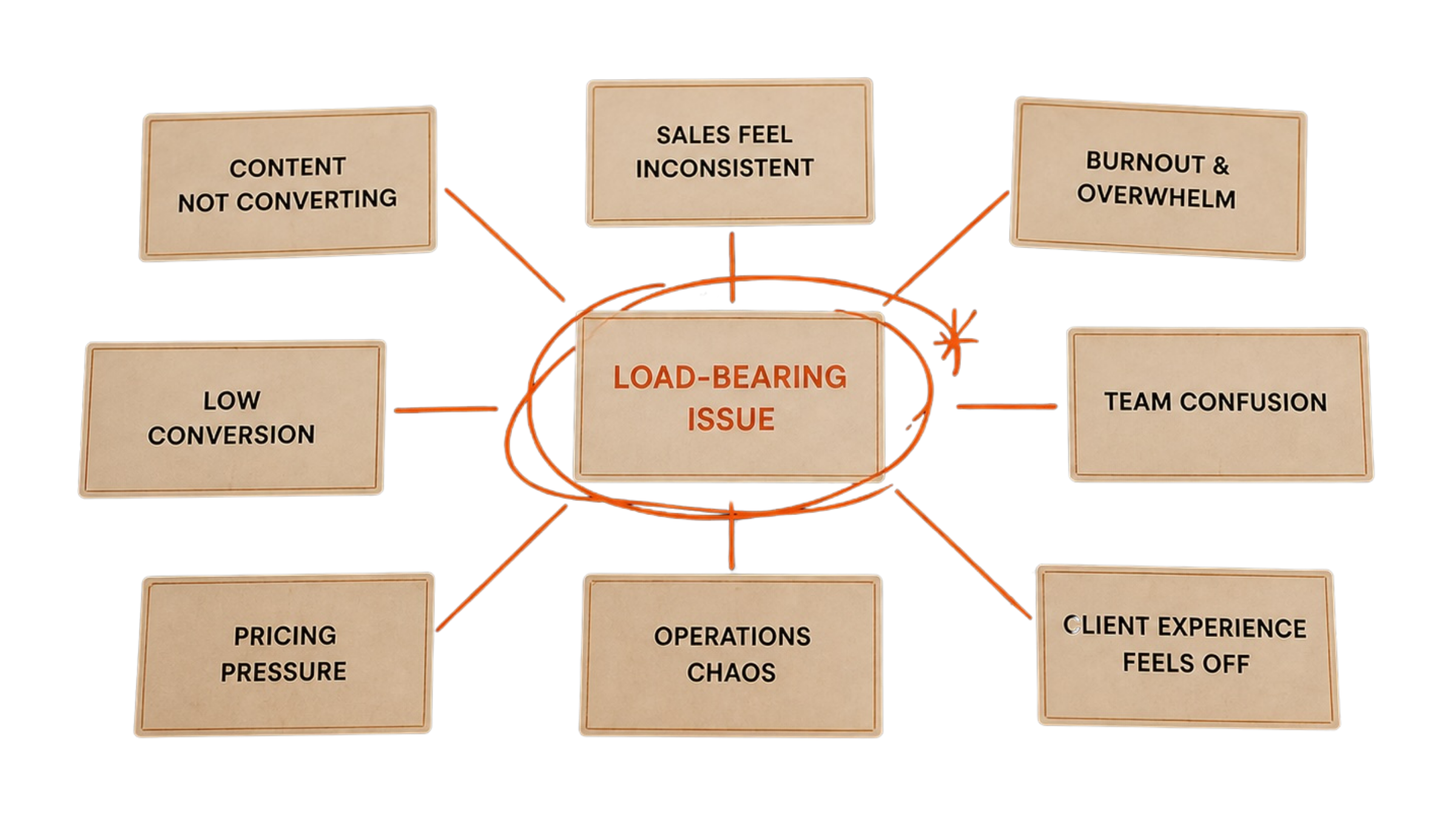
Let's connect the dots.
Load-bearing issue diagram showing how one structural problem connects to content, sales, conversion, team, pricing, operations, burnout, and client experience
Veronica Dietz

Is This Actually Load-Bearing?

Run the problem through this test before you spend another weekend rebuilding the wrong thing.

01

Does it show up in more than one place?

Content, sales, delivery, pricing, team, or your calendar.

02

Does it keep coming back in a new outfit?

You fix it, rename it, reorganize it, and somehow it's still there.

03

Does it change how you make decisions?

You delay, over-explain, discount, avoid, overwork, or start over.

If one issue is distorting multiple decisions, it's probably not a task. It's structural.
Why This Feels Off neon sign
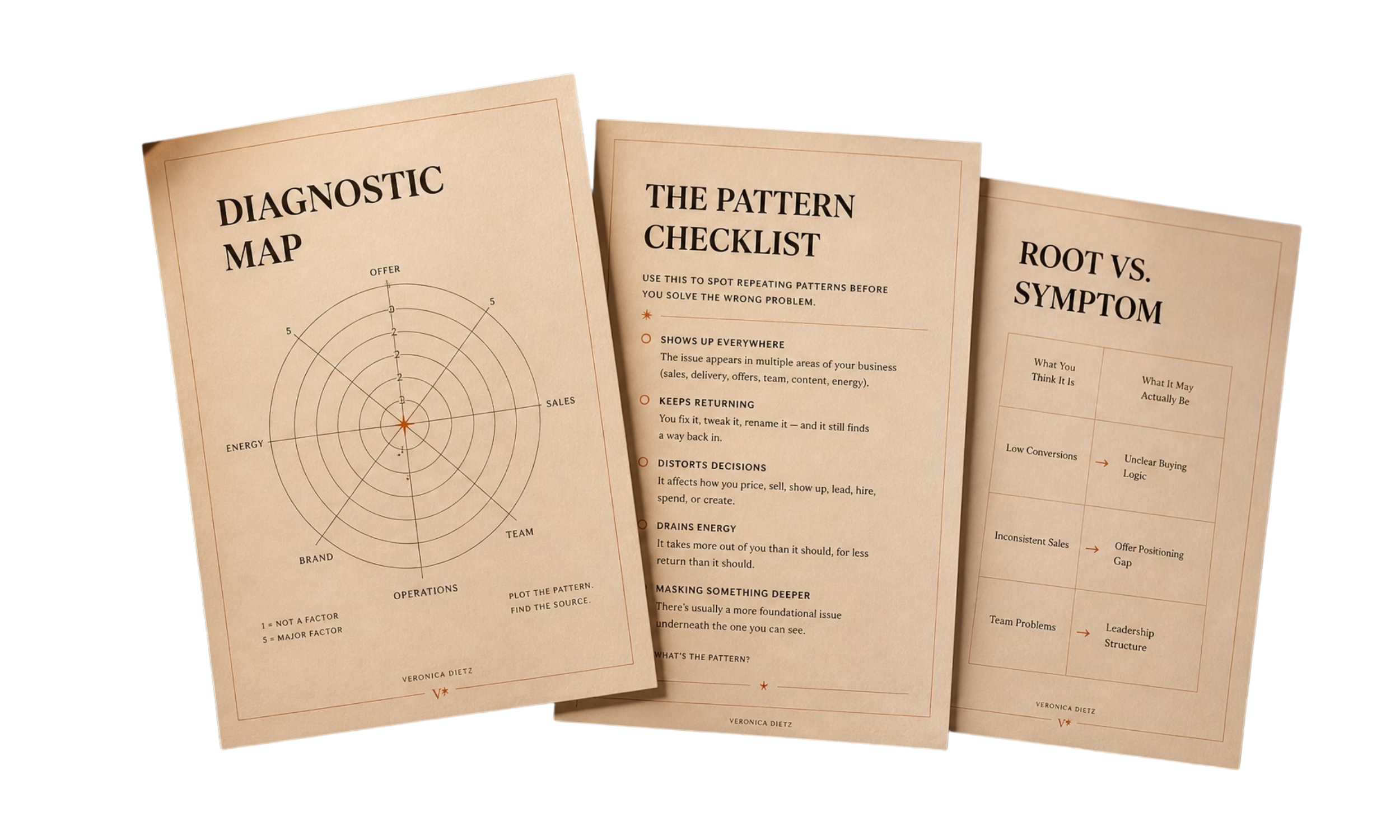
Why This Feels Off diagnostic bundle pages: Diagnostic Map, The Pattern Checklist, Root vs. Symptom

Do Not Rebuild the Whole Room Yet.

Find what's
actually off.

Why This Feels Off is a free diagnostic bundle designed to help you identify where the misalignment may actually be coming from, before you spend more time, money, or energy solving the wrong problem.

Get Why This Feels Off
Clarity first.
Then the right moves.

Common Questions

What founders ask before naming theirs.

If you're still wondering whether the issue you're feeling is structural or just noise, start here.

A regular business problem stays in its lane. A load-bearing issue distorts everything around it. If you fix a regular problem, the rest of the business keeps moving. If you try to fix a load-bearing issue without naming it first, you usually rebuild three things that didn't need rebuilding and the original issue still shows up next quarter wearing a different name.

The tell is scope. One symptom in one place is probably a task. The same symptom showing up in your offer, your sales calls, your team meetings, and your calendar at the same time is structural.

Usually one is doing most of the work. There may be two or three smaller structural issues stacked on top of it, but they tend to be downstream of the main one. When founders try to name three at once, they almost always end up describing the same root issue from three different angles.

The faster move is to name the loudest one first, sit with it for a week, and then ask whether the other two still feel as urgent. Most of the time they get quieter on their own.

Most coaching and strategy work starts with a prescription. New offer, new funnel, new pricing, new system. The assumption is that you know what's broken and you need help fixing it.

Diagnostic work starts a step earlier. The first job is naming what's actually misaligned, before anyone touches the offer or the funnel. Sometimes the diagnosis confirms what you already suspected. Sometimes it reframes the problem entirely. Either way, the prescription that comes after lands harder because it's solving the right thing.

You're ready when you've stopped trusting your own list of what's wrong.

Most founders try four or five fixes before they get here. New launch, new hire, new offer, new strategy. When the same feeling keeps coming back regardless of what you change, that's the moment a diagnostic is useful. Trying to find your load-bearing issue while you're still mid-fix on the last thing usually just adds another layer.

Sometimes. Naming it correctly is most of the work. Once you can say out loud what your business is actually built around, a lot of the next moves become obvious — what to stop doing, what to stop hiring around, what to stop pricing for.

The part that's harder to do alone is the naming itself, because the issue is usually wearing a costume you helped make. An outside read tends to spot it faster than you can.

The diagnosis itself is usually one conversation, sometimes two. The harder part is the week or two after, where you sit with what got named and decide what you're willing to change. Most founders don't need months of strategy work after a diagnosis. They need 60 to 90 days of acting on what they finally know.

Still not sure if yours is structural or just noise?

Start with Why This Feels Off