You've done the work. The results still don't hold.

If you've done the work, hired the help, followed the right advice, and still find yourself rebuilding, you're not reading this by accident.

This page exists for founders and operators who can execute but whose results don't compound. Who know something is off but can't locate what it actually is. Who are tired of collecting strategies that make sense but don't hold.

You don't need more information. You need a correct read of what's actually happening.

Black and white photo of a person in a leather jacket facing away with a blurred shadow effect.
Person wearing black clothing typing on a white Apple laptop while seated on a textured white surface.
You might be here because

You keep changing your strategy even when things are working.

You've invested in coaches, consultants, or courses and still feel like something underneath it all isn't resolved.

Advice keeps adding complexity instead of relief.

Nothing compounds despite consistent effort.

You sense a shift coming but can't name it clearly enough to act on it.
Every new quarter starts with a version of the same problem wearing different clothes.

You're not stuck because you stopped trying. You've been trying precisely. The problem is what you've been trying to solve.

The problem isn't effort. It's interpretation.

At some point, your business changed. What you sell, who it's for, what it means, something shifted. But the decisions you're still making come from the version before the shift.

So you keep executing with precision inside a frame that no longer fits. The strategy feels unstable. Advice conflicts. Progress resets. Not because you're doing it wrong, but because you're solving a problem that already expired.

Most people assume they missed something tactical. They didn't. They've been solving the wrong problem with precision.

That's not a motivation problem. It's not a consistency problem. It's an interpretation problem. And more effort doesn't fix it. Only correcting the interpretation does.

This is not coaching. It's not consulting. It's not another framework.

It's a second opinion on the situation you keep trying to fix.

I follow the decision chain backward until the contradiction shows up. Most problems people bring aren't actually the problem. They're the consequence of an earlier misread that went unnoticed. Once the false interpretation is removed, the correct decision surfaces on its own.

People often arrive asking about marketing or positioning. They leave having resolved something earlier than that. Not because we worked on mindset or motivation. Because the situation finally made sense.

Who this is for

Service-based operators. Consultants, designers, therapists, agency owners, coaches who are tired of coaching their own marketing instead of doing their real work.

People in the late early stage to mid six figures who can execute but whose results don't compound.

People who have already tried the obvious fixes.

Smiling young woman with wavy brown hair inside a cozy room with plants and wooden furniture.
Woman sitting indoors reading a book with a plant and wooden furniture in the background.

Where to start

There is a natural progression to this work. Not a funnel. A sequence based on where you actually are.

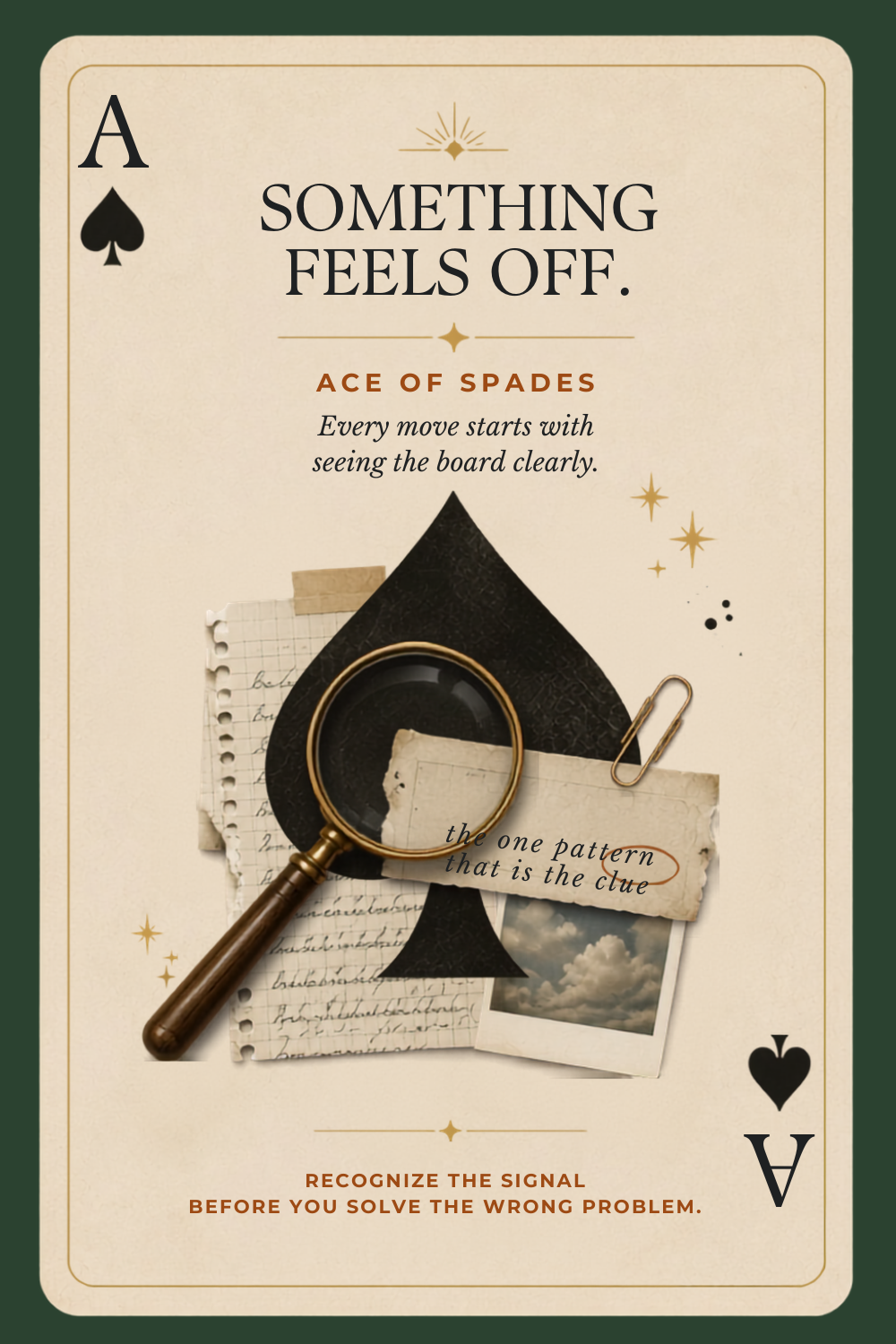
Something feels off but you can't locate it yet.

Start with Why This Feels Off. A self-directed diagnostic that helps you name the pattern before anything else. $99.
You have a specific decision that won't settle.

A Business Second Opinion is 90 minutes. We look at what's actually driving it and you leave with a stabilized decision. $497.
The pattern keeps resetting no matter what you resolve.

Stop Starting Over is a 12-week private engagement for founders who keep rebuilding their own momentum. Limited availability. $7,500.

You want to stay oriented between the moments that require direct intervention.

The Perspective Room is an ongoing private environment where the thinking continues. First access to everything. $33 per month.

A note before you decide anything

You don't need to know which one is right before you reach out.

The most common thing people say when they find this work is that they wish they had found it earlier. Not because the work is extraordinary. Because the problem they were carrying had a name, and nobody had named it yet.

If something here feels like recognition rather than information, that's usually the signal.