
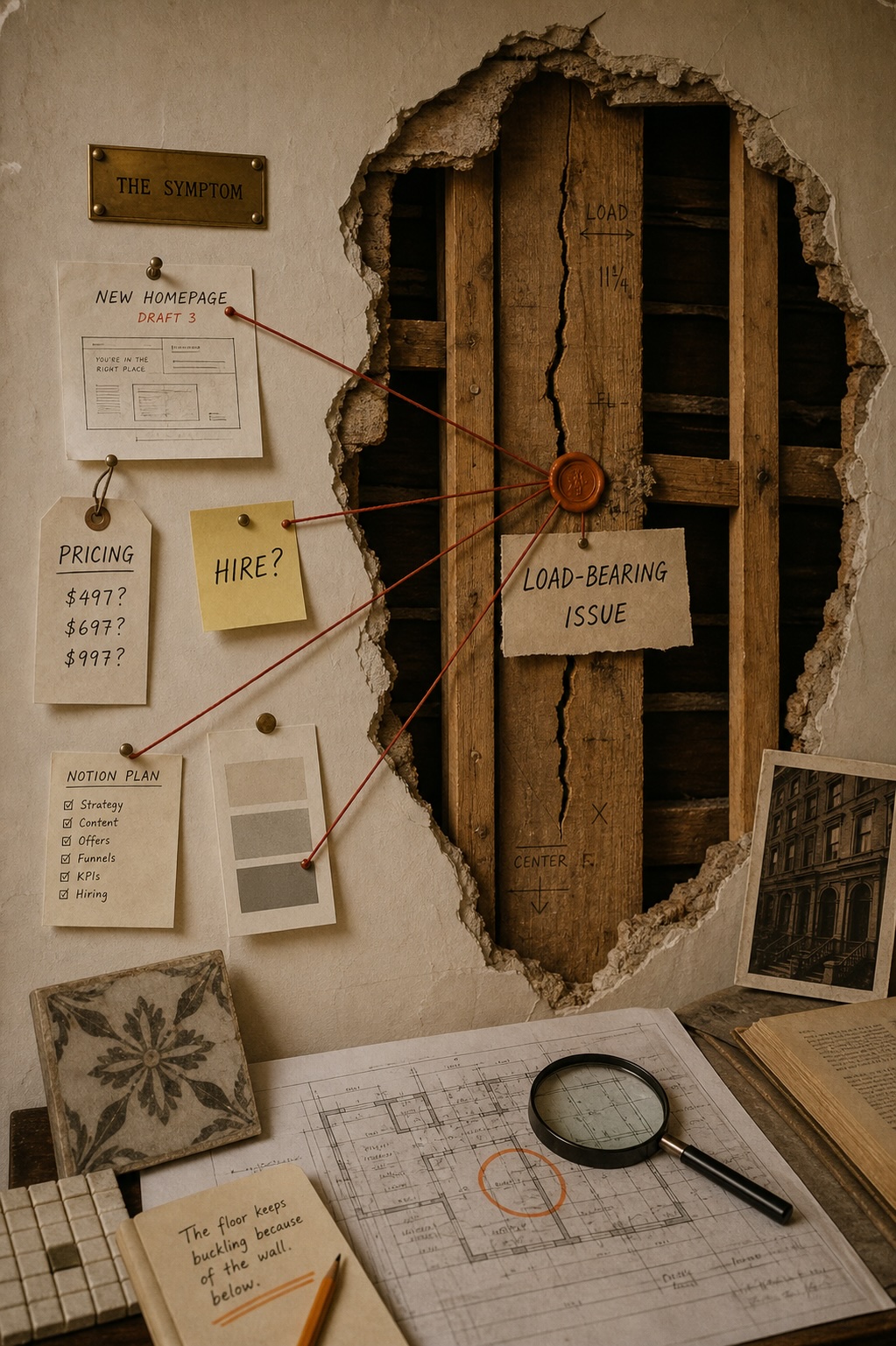
The Symptom You Keep Treating Isn't the Problem
There is a problem in your business that has been broken for at least nine months.
By my count, you have treated it five different ways. You have rewritten the page. You have changed the price. You have hired a person, fired a person, hired a different person. You have bought the course about it. You have built a Notion doc about it that you are quietly proud of.
And the problem is still there.
If that opening landed, this post is for you. The reason the problem keeps coming back is not that you're undisciplined or under-skilled. It's that you are treating the wrong layer. You are working on the visible thing, the thing waking you up at 2 a.m., the thing you can describe in one tense sentence to a friend at brunch. But the visible thing is not the problem. It's the symptom of the problem.
The actual problem is somewhere underneath. Almost always, it's a structural decision you made early in the business that is now silently producing most of the symptoms you keep trying to fix. I call this the load-bearing issue. This post is going to walk you through what it is, why you can't see your own, and what to do about it.
What a Load-Bearing Issue Actually Is
In construction, a load-bearing wall is the wall that holds the building up. You can renovate around it. You can paint it, hang things on it, decorate it. But if you remove it without replacing the support, the building comes down.
Businesses have these. One structural decision, or one structural absence, that is currently holding up most of the symptoms you are seeing. It's almost always something you decided very early. When you didn't yet know what you didn't know. When you were trying to make rent and prove a thing to yourself.
That decision made sense at the time. So you built on top of it. Then you built on top of that. Then you built on top of that.
Now the business is six floors up. The original decision is in the basement. You haven't visited it in years. And every weird thing happening on the top floor is downstream of a wall in the basement that you don't even remember putting in.
The reason this matters: most business advice operates at the top-floor level. Better headline. Better funnel. Better hire. Better content cadence. Better email subject line. None of those things move structure. They move tile. Tile is not the wall.
If you keep changing tile and the floor keeps buckling, the tile was never the issue.
Symptoms vs Structure: How to Tell Them Apart
Every business has symptoms. Numbers that aren't where you want them. Patterns that keep recurring. Conversations that go quiet at the same point every time. A vibe in your business you don't quite love.
Symptoms are loud. They are the thing you can articulate. They show up on dashboards. They make you anxious in specific, nameable ways.
Structure is the thing underneath. Structure is how the business is actually built. The decisions you made early about who you serve, what you sell, how you deliver, what your offer ladder looks like, what you charge, who your team is, how money moves through the system.
Symptoms change month to month. Structure does not change unless you change it.
Here is a quick way to tell which one you're holding. Ask yourself: if I treated this issue successfully today, would something else recurring in the business also resolve, or would I just be back here next quarter with a new variation of the same problem?
If treating it would only solve this specific instance, it's a symptom. The wall is somewhere else.
If treating it would also resolve other recurring patterns, you've found the structure.
Common Symptoms That Are Almost Always Downstream of Structure
These are the recurring complaints I hear most often that turn out, on examination, to be structural issues wearing tactical clothes:
Conversion that won't move no matter what you change on the page. Often, the page is fine and the offer underneath the page is the issue. Sometimes you have outgrown what you're selling and the marketing is doing the work of trying to convince yourself, not the buyer.
Hiring that keeps failing in the same role. Often, the role itself is structurally wrong. The job description is downstream of an org design that's missing a layer. You can't hire your way out of a structural gap.
Pricing paralysis where you can't tell if you're underpriced or just underconfident. Often, the issue is positioning. You haven't built the architecture that supports the price you want to charge, so the number feels arbitrary.
Content that keeps almost-working. Often, the messaging is downstream of an unresolved question about who you actually want to serve. You can't write sharp content for an audience you have private mixed feelings about.
Team friction that follows the founder from team to team. Usually structural. The way decisions move through the company is misaligned with how the founder actually decides.
Why You Can't See Your Own Load-Bearing Issue
Quick housekeeping: the reason you have not found this on your own is not that you are not smart enough. We've established you are smart. That is part of the problem we're working with.
You can't see it because you made it. You have a relationship with it. It feels like part of the building, not a thing inside the building.
This is the same reason therapists have therapists. The same reason editors don't edit their own books. The same reason you can't tell when your own apartment smells like something. You're inside the air.
There is also a more specific reason. The decision you made early was probably made under conditions you have since forgotten. You were a different person. You knew different things. The decision was correct for the founder you were at the time, and you have grown past the conditions that made it correct, but the decision is still in place.
Updating it requires going back into the basement, finding the wall, and asking whether it's still load-bearing or whether the building has reorganized itself around different supports. That is hard to do alone, because you are inside the building.
It is much easier with someone outside who can walk through and tell you what they see.
A Real Example: When Conversion Wasn't About Conversion
Let me make this concrete. The story is composite. Identifying details changed. The shape is real.
A founder books a Direction Session because her offer isn't converting. She wants help with conversion. She has redone the sales page twice. She's tested two new lead magnets. She has a spreadsheet of A/B tests. She has read the books about it.
On the call, within twenty minutes, it is so clear. The offer is fine. The page is fine. What is not fine is that she does not want to deliver this offer anymore. She outgrew it about eighteen months ago. She doesn't believe in it the way she used to.
Every email she has been writing for it has a quiet flatness underneath it because the person writing it does not actually want the buyer.
That is the wall in the basement. The whole front end of her business is built on top of an offer she has internally moved on from. You cannot fix that with a better subject line. You can fix it with a real conversation about what she actually wants to sell now. But that conversation requires her to admit she has been treating the wrong thing for a year and a half.
That admission is hard to make alone. That is what an outside read is for.
After that Direction Session, she walked away with a 90-Day Decision Map that included the sequence for sunsetting the old offer, the structure of what would replace it, and the timing for both. The strategy was concrete. It just couldn't be built until the diagnosis happened.
How to Start Finding Your Own Load-Bearing Issue
I am not going to ask you to figure this out in the next ten minutes. That is not how this works.
What I am going to ask you to do is name the symptom precisely. Not the category. The actual recurring thing.
Not 'my marketing isn't working.' That is a category. Categories are useless.
Specifically: 'I rewrite my homepage every six weeks and it never feels right.'
Specifically: 'Every operations hire I have made in three years has left within nine months.'
Specifically: 'I keep adding small offers to fill revenue gaps and none of them stick.'
The specificity is the diagnostic surface. Vagueness is part of why you have not seen the structure yet. When the symptom is named precisely, the structure underneath it becomes possible to see. When it stays vague, the structure stays hidden.
Three Questions to Get Specific
Use these to pressure-test what you think the problem is.
First, when did this issue start showing up? Not approximately. Try to remember the actual stretch of time. The answer often points you to what changed in the business around that period, which often points you toward the structural shift you missed.
Second, what does this issue have in common with the last issue you tried to fix? If the through-line jumps out at you, that's data. The recurring pattern is the structure.
Third, what would have to be true about your business for this issue to not exist? Don't answer with a tactic. Answer with the conditions. If the conditions sound like a different business, you've found a hint about the structural shift you might be due for.
Why Founders Default to Tile-Changing Instead of Wall-Examining
It is worth understanding why most of us, myself included, default to tile-changing. The reason isn't laziness. It's that tile-changing is fast, visible, and feels productive.
If you change a headline, you can see the result by the end of the week. The number either moves or it doesn't. Even if it doesn't move, you tried something. You can show your team. You can document the experiment. It looks like work.
If you go look at the wall, the work is invisible from outside. You might spend two weeks just sitting with a question. There's no Slack message that says 'I have decided that the offer I built two years ago no longer serves the business I'm running.' There's no progress report on existential examination. The work is real, but it doesn't look like work the way tile-changing does.
So we default to the visible work. We change the headline. We tweak the funnel. We test a new lead magnet. We feel productive. The wall stays where it is.
This is also why founders with high accountability cultures (mastermind groups, weekly team meetings, public goal-setting) often have the hardest time finding their load-bearing issues. Their environments reward visible motion. There is no place in their week reserved for examining the foundation. So the foundation gets examined only in moments of crisis, after the visible motion has stopped working.
If you want to find your load-bearing issue, you have to deliberately make space for invisible work. The space looks like nothing from outside. That is what makes it work.
How to Tell If You're Reading This Post for the Right Reason
Quick gut check before you keep going.
Some founders read a post like this and feel relief. The relief is the recognition of something they have suspected for a while. They were already moving toward this kind of examination, and the post gave them language for it. If that's you, you are likely close to seeing your structure. The free tool is going to be useful. The Direction Session, if you eventually book it, is going to be a confirmation and a strategic plan, not a revelation.
Some founders read a post like this and feel resistance. The resistance is also useful. It usually means there is a structural issue you have been avoiding looking at, and a part of you is hoping this post won't ask you to. If that's you, the resistance is the data. Whatever surfaces when you read 'load-bearing issue' and feel a small flinch is probably the area worth examining.
Some founders read a post like this and feel performative agreement. They are nodding along, mentally drafting a Threads post about the importance of structural thinking, but nothing has actually surfaced for them. If that's you, the post might be hitting at a moment when you are not actually stuck. That is fine. File it for later. The work is most useful when something in you is already cracking open.
Whichever of these you are right now, the framework still applies. The starting point is just different.
What Changes When You Find Your Load-Bearing Issue
I want to describe what actually shifts in a business once the founder finds the structural piece, because this part rarely gets talked about. The shift is more subtle than people expect, and I think the realistic version is more useful than the dramatic version.
The first thing that shifts is your decision-making speed. Once the load-bearing issue is named, decisions that used to feel impossibly weighted become straightforward. You are no longer trying to make decisions while a hidden structural conflict is silently distorting every option. The decision was hard before because it was being made in the wrong frame. Now it is being made in the right one. The same decisions that took you weeks now take you a meeting.
The second thing that shifts is what you stop doing. Most founders, after diagnosis, sunset something. An offer. A program. A platform. A meeting cadence. A whole strategy. The reason isn't that they have more energy. It's that they finally see what was draining the energy in the first place, and the choice to stop becomes obvious. You don't need to push through the resistance. The resistance disappears once the conflict it was protecting is named.
The third thing that shifts, and this is the most surprising, is your team and your audience. Once you are no longer building the business around an unresolved structural question, the people around you can feel the difference. Your team gets clearer because you are clearer. Your marketing gets sharper because the underlying message stops competing with itself. New people start showing up who fit the version of the business you are actually trying to build. Old people, sometimes, gracefully exit because they were aligned with the old version.
None of this is dramatic. None of it is overnight. But six months after finding the load-bearing issue, founders almost always describe their business as 'cleaner,' 'lighter,' or 'finally making sense.' That language is the language of structural integrity. The building is being held up by the right walls now.
Why This Feels Off: The Free Tool to Take This Further
If this post named something you've been circling for a while, the next step is the free tool I built specifically for this work.
It's called Why This Feels Off. It includes a guide that walks you through the diagnostic move I just described, the Diagnostic Partner AI tool that asks you the structured questions you would not ask yourself, and email support from me as you work through it.
The closest description I can give is: it's the work of a Direction Session, but you do it with yourself, with me supporting via email along the way. It costs nothing. It is genuinely substantive. People have used it and gotten clear enough on their load-bearing issue that they didn't need to book a call afterward, which is a perfectly good outcome. The free tool worked. They can go run their business.
Other people use it and they can feel that they have hit something underneath that they cannot get to alone. That is when the paid call becomes the right next step.
Either way, start here. The free tool is built to be substantive. It is not a quick win. It is not designed to make you hungry for the paid call. It is designed to do real diagnostic work with you, and if that work is enough, the work is enough.
Get Why This Feels Off (free): includes the guide, the Diagnostic Partner AI tool, and email support from Veronica. Link in the article footer.
When You Need a Direction Session Instead
If you finish the free work and you can feel that something structural is happening but you cannot get your hands on it alone, that is the moment a Direction Session is built for.
It is sixty minutes. Five hundred dollars. You bring the question. I read the situation. We get clean on what is actually going on, and you walk away with a 90-Day Decision Map that shows you the specific moves and the timing to put your read into action.
Important note. The Direction Session is not limited to load-bearing issue work. It is the right call for any business question where you need an outside read and a path forward. Examples I get all the time:
Hiring questions. You're about to make a senior hire and you want to pressure-test whether the role is structured correctly, what to look for, what to avoid, and how to onboard them so they don't churn at month nine.
Investment questions. You have a budget and you are not sure where it should go. New offer development versus better infrastructure versus a hire versus paid traffic. We get clean on what the highest-leverage move is for your specific business right now.
Ad performance. Your ads are converting at half the rate you need and you are about to throw more spend at the problem. We work through what is actually breaking in the funnel before you light more money on fire.
Pricing and positioning. You are considering a price increase or a repositioning and you want to know if the architecture supports it before you announce it publicly.
Offer questions. New offer, sunset offer, restructured offer ladder, premium tier, downsell. You bring the question, we sort which moves serve the business as it actually is.
All of these come with the same deliverable. The read on what is actually happening, plus the 90-Day Decision Map showing you the specific moves and timing for the next quarter. You walk away with both the diagnosis and the strategy.
Book a Direction Session: $500, 60 minutes, includes a 90-Day Decision Map. Link in the article footer.
The Bottom Line
If you have been treating the same problem in your business for nine months and nothing has changed, you are not under-skilled. You are working on the wrong layer.
The visible thing is rarely the problem. The thing producing the visible thing is the problem. And you almost certainly cannot see your own structure clearly from inside it, because you built it.
Start with the free tool. Get specific about your symptom. See if the structure underneath becomes visible to you when you slow down. If it does, you may not need anything else. If it doesn't, that is exactly what the Direction Session is for, and you'll walk away with both the read and the 90-day plan.
Either way, stop changing tile. Go look at the wall.