
The Decisions You're Avoiding Are the Business
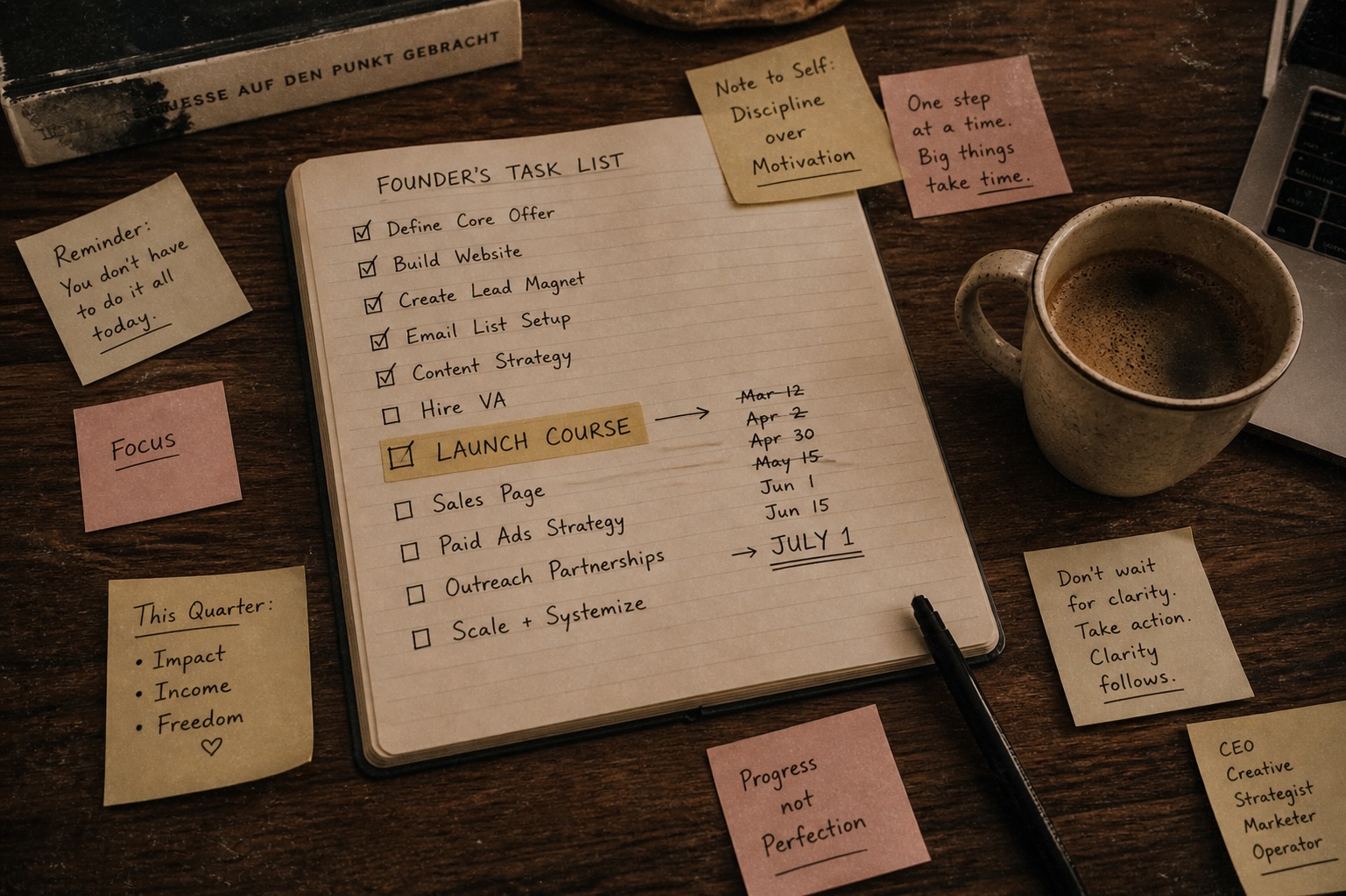
There is a thing on your task list right now that is not actually a task.
You have moved it to next week three times. Maybe four. It has been sitting there, technically active, definitely not getting done. You have made eye contact with it every Sunday during your weekly review and looked away.
It is not a task. It is a decision. And you don't want to make it because making it costs something.
Maybe money. Maybe a relationship. Maybe the version of yourself who didn't yet know what the right call was, because once you make the decision, that version is gone.
So you keep moving it. And meanwhile, the business is being built around the absence of that decision. The absence is doing more shaping in your business than your strategy is.
This post is about that. I am going to walk you through how to spot a decision masquerading as a task, why you are avoiding it, what it is silently costing you, why you usually cannot make these decisions alone, and what to do about it.
Decisions Disguised as Tasks
First move: learn to spot the difference.
A task is something you know how to do, and you just need to schedule it. Write the email. Update the contract. Send the invoice. Schedule the call.
A decision is something where you don't yet know what the right move is, or you do know and you don't yet want to make it. Decisions involve a fork. Tasks involve a checkbox.
These get confused because decisions are often phrased as tasks. 'Update the contract' might be a real task. Or it might be a decision wearing task clothes: do I keep this client, do I raise the price, do I terminate the agreement entirely. The phrasing makes it look like a thirty-minute admin item. Underneath, it is a fork in the road.
Here is the rule I use. If a 'task' has been on your list for over two weeks and the world has not moved it forward, it is almost certainly a decision. The reason it is not getting done isn't bandwidth. It is that you have not decided yet.
The reason this matters is that you cannot complete a decision the way you complete a task. You can't carve out a thirty-minute slot, sit down, and check it off. Decisions require a different kind of work. They require sitting with the tradeoffs, examining what you are actually weighing, and accepting that making the call closes a door you have been quietly leaving open. That is not a thirty-minute slot. It is a different mode entirely.
If you are treating decisions like tasks, you will keep moving them, and you will keep wondering why your task system isn't working. Your task system is fine. The items in it are mismatched.
Open your task list. Find the item that has been there longest. Look at it. Is it a task or a decision? Be honest. The longer it has been there, the more likely it's a decision.
The Three Reasons You're Avoiding It
In my work, when a founder brings me a decision they have been avoiding for months, the reason almost always falls into one of three categories. Sometimes one. Often two. The genuinely stuck founders are all three.
Reason One: Relationship
Ending something with a client, a team member, a partner, a contractor. The decision itself is clear. The relationship makes it expensive. So you defer.
This shows up most often with long-time clients who have outgrown the offer they bought, with team members who were the right fit for the previous version of the business but not the current one, and with business partnerships that started in a different season and have not aged the way you hoped.
The avoidance feels like loyalty. Sometimes it is. More often, it is a way to keep yourself from being the person who ended something. We are taught that ending things gracefully is hard, and so we rationalize letting them drift instead. The drift is its own kind of unkindness, but it is invisible, so it doesn't trigger the same internal alarm.
Reason Two: Admission
Making the decision means admitting something to yourself you have not yet admitted. That an offer didn't work. That a hire was the wrong one. That a direction you committed to two years ago is not where you are actually going.
The decision exposes the prior judgment, and your ego does not love that for you.
This is one of the most common reasons founders avoid sunsetting offers, repositioning, or changing pricing structures. Making the change means publicly (or even internally) acknowledging that you were on the wrong path. People who built their business on conviction find this particularly hard, because conviction is part of how they got here.
But conviction has an expiration date. The version of conviction that started the business is not the same version that sustains it five years in. Updating your conviction is not a betrayal of the original move. It is the move maturing.
Reason Three: Identity
The decision changes who you are. Raising the price means becoming someone who charges more. Sunsetting an offer means becoming someone who runs a different business. Hiring a senior person means becoming someone with a real team, not a freelancer with helpers.
The decision requires identity movement, and identity is sticky.
This is the deepest of the three reasons, because it is the least visible. You can usually name a relationship reason. You can sometimes name an admission reason. Identity reasons mostly hide. They show up as 'I'll do it when I'm ready' or 'I want to be more sure first' or 'the timing isn't right.'
The timing is fine. You are not yet the person who has made the decision. The decision is what makes you that person. You don't grow into the identity first and then make the call. You make the call and the identity catches up. But that order feels backwards, so you wait.
The Cost of Not Deciding
Things nobody tells you about avoided decisions.
Not deciding is a decision. It is the decision to keep things as they are. Just one you didn't make consciously, so you don't get the credit for it, but you also don't get to claim you didn't choose.
And the cost compounds. Every week you don't decide, the business reorganizes around the avoidance. The team plans around the unspoken thing. The marketing aims at the unclear positioning. The roadmap accommodates the offer you are not sure you want to keep.
Six months later, you have built infrastructure around something you weren't even sure of. Now the cost of changing it is higher than it was when the decision first showed up.
The decisions you avoid become the architecture. That is not a metaphor. That is what is actually happening to your business right now.
Common Avoided Decisions and What They Cost
Some examples I see often, with the actual cost shape.
Avoided sunset of a stale offer. Cost: marketing energy spent on something the founder has internally moved on from, leaking conversion. Team time spent maintaining and selling something that is no longer the priority. Mental load of carrying the unspoken decision. Most importantly: the offer that would have replaced it is not getting built, because the founder hasn't cleared the space.
Avoided client end. Cost: emotional energy on a relationship that has run its course. Hours per month spent on someone who is no longer aligned. The slot they occupy is not available for the kind of client the founder actually wants now. The longer it goes, the more the founder resents the work, which leaks into other client relationships.
Avoided team change. Cost: a role held by someone who isn't the right fit, which means the role isn't producing what it should, which means the founder absorbs the gap, which means the founder is doing the role they hired someone else to do. Compounding revenue loss and burnout.
Avoided price increase. Cost: every new client priced at the old rate, which compounds over the lifetime of that client. Identity cost of being someone who knows the price is wrong and is choosing not to fix it.
Avoided positioning shift. Cost: marketing aimed at people you don't actually want to attract. The audience builds around the wrong center. Repositioning later requires undoing the audience work, which is harder than building toward the right audience from the start.
Why You Can't Decide Alone
Some decisions you can make alone. The clean ones. The right answer is obvious. You just need to schedule the conversation.
The ones I am talking about, you usually cannot make alone. Not because you are incapable. Because the reason you have been avoiding them is itself preventing you from seeing them clearly.
If you avoided because of relationship, you'll keep finding reasons it isn't the right time. Your brain will generate new evidence every week that the situation might still resolve. That is not analysis. That is avoidance dressed up as patience.
If you avoided because of admission, you'll keep reframing the prior call so the new call doesn't look like a reversal. That is not strategy. That is image management.
If you avoided because of identity, you'll keep waiting until you feel ready. You will not feel ready. The readiness comes after the decision, not before. But you don't know that until somebody tells you.
This is where outside voice matters. Not to make the decision for you. To name what is actually happening so you can stop dressing it up.
What 'Outside Voice' Actually Means
Specific, because 'get an outside voice' is generic advice and most people misapply it.
Outside voice is not your business friend who agrees with you. She will tell you it is a hard call and you'll know when it's right. That is not useful. That is permission to keep avoiding wrapped in a soft cardigan.
Outside voice is not your therapist. Your therapist is sacred and important. She is helping you sit with the feeling. That is her job. It is not the same job as helping you make the structural call.
Outside voice is someone who can read your situation, see the avoidance for what it is, and name the actual decision in front of you in a way you can't dismiss. That is a specific skill. Most people aren't trained for it. The ones who are tend to do it deliberately, in time-bounded containers, for a fee. Because when you do it for free in casual conversation, the social fabric makes the truth difficult to land.
A Real Story: When 'Help Me Reposition' Was 'Give Me Permission to Sunset'
Composite. Identifying details changed. The shape is real.
A founder books a Direction Session. She tells me the situation. She has an offer that has been her main revenue driver for three years. The offer performs. The numbers are fine. But she has been quietly miserable about it for almost a year. She doesn't want to deliver it anymore. She knows this. She has not done anything about it.
On the call she says, 'I think I need help repositioning the offer or finding a way to deliver it that doesn't drain me.'
That is the framing she walks in with. Repositioning. Operations. Tactical.
Twenty minutes in, I tell her what I actually see. 'You are not asking me how to reposition this offer. You are asking me for permission to sunset it. You have already decided. You just don't want to be the one who said it out loud first.'
Quiet for about ten seconds.
Then she said, 'Yeah.'
The rest of the call was her starting to map what sunsetting actually looked like. What replaces it. How she communicates it to existing clients. What the timing should be. The 90-Day Decision Map that came out of that call gave her the specific sequence: announcement timing, transition period for active clients, structure of the new offer that would replace it, sequence for the launch.
She didn't need a strategist. She didn't need a coach. She needed someone outside the situation to name the decision accurately, and then map the strategic plan to act on it. The work was both: the read, and the path forward.
What is the decision you have already made that you haven't said out loud yet? You probably know which one I mean.
How to Surface Your Own Avoided Decision
Some questions to ask yourself before you book any kind of help.
Question One: What Has Been on Your List the Longest
Open your task list, your project tracker, your notebook. Find the item that has been moving forward without resolving for the longest. Look at it. Is it a task or a decision?
If it has been there over a month, it is almost certainly a decision.
Question Two: What Are You Quietly Hoping Will Resolve Itself
There is something in your business right now that you are hoping the situation will solve for you. A client whose contract is ending soon and you're hoping they don't renew so you don't have to end it yourself. A team member whose performance has been dipping and you're hoping they will quit. An offer that you keep talking about retiring 'when the time is right.'
The thing you are hoping resolves itself is the decision you are avoiding. Naming what it is, even just to yourself, is the first move.
Question Three: What Does the Avoidance Cost
Try to put numbers on it. Not exact. Estimates.
The client you have been meaning to end. How many hours a month does that work take? What is the opportunity cost of those hours being unavailable for the work you actually want to do?
The price you have been meaning to raise. How many new clients have you taken at the old price since you knew you should change it? What is the lifetime value gap between the old price and the new one?
The offer you have been meaning to sunset. How much marketing energy goes into something you have internally moved on from? What hasn't been built because that energy was occupied?
Once you put numbers on the avoidance, the math usually shifts. The decision starts looking less like a risk and more like an overdue correction.
What Happens After You Make a Long-Avoided Decision
I want to be honest about what the after looks like, because most content about hard decisions stops at the decision itself. The decision is one beat. The aftermath is several.
First, you usually feel relief, and the relief surprises you. Founders who have been avoiding a decision for months expect that making it will feel hard. It often feels lighter than they imagined. The weight wasn't the decision. The weight was carrying the unmade decision around. Once it is made, the weight goes.
Second, you sometimes regret the timing. Not the decision itself, but the fact that you waited as long as you did. This regret is usually short-lived and useful. It is the data that helps you make the next avoided decision faster. Founders who go through one significant avoided-decision cycle often make the next one in weeks instead of months, because they remember how much heavier the avoidance was than the decision turned out to be.
Third, the business reorganizes. If you sunset an offer, the marketing energy that was going into it gets redirected. If you end a client relationship, the time and emotional bandwidth become available for new work. If you raise a price, the new clients who come in at the new rate are different from the old ones, and your business slowly starts to feel like a different kind of business. None of this is dramatic. It is just the gradual rebalancing that happens once the structural distortion is removed.
Fourth, and this is the most important, you become someone who makes decisions on time. The next avoided decision is harder to avoid because you remember what avoidance cost you last time. Over time, founders who go through a few of these cycles become genuinely different operators. They have less unfinished business in their heads. They make calls when calls are needed. They stop accumulating the silent debt of postponed decisions.
This is the version of you that is on the other side of the decision you are currently avoiding. It is worth the cost of getting there.
How to Build a Practice That Catches Avoided Decisions Earlier
Once you have done this work once, you can build small practices that catch avoided decisions earlier in the cycle, before they become months-long drift.
First practice: a quarterly task list audit. Every quarter, look at what has been on your task list the longest. Anything over six weeks gets evaluated as a possible decision. You don't have to make the decision in that audit. You just have to name it. Often, naming it as 'this is a decision I am avoiding, and the decision is ___' is enough to start the resolution process.
Second practice: a 'what am I hoping resolves itself' check. Every two weeks, ask yourself this one question. The thing you are hoping resolves itself is almost always a decision you are postponing. The earlier you catch it, the cheaper the eventual resolution.
Third practice: a 'one decision per quarter' commitment. Pick one decision per quarter that you are going to make, even if you don't yet feel ready. The decision can be small. The point isn't the size of the decision. The point is the practice of making decisions on time. Over a year, four decisions made on time is the difference between a business that operates with integrity and one that drifts.
Fourth practice: a check-in cadence with someone outside your loop. Whether that's me, another advisor, or a peer who is structurally different from you, having a regular cadence with someone who can name what you are avoiding before it becomes a crisis is one of the highest-leverage practices a founder can build. Quarterly is enough. Monthly is generous. The cadence itself is the practice.
Where to Start: Why This Feels Off
If this post named a decision you have been moving around, the right next step is the free tool I built specifically for this work. Why This Feels Off includes a guide that walks you through the diagnostic move I just described, the Diagnostic Partner AI tool that asks you the structured questions you would not ask yourself, and email support from me as you work through it.
Some founders work through the tool and the decision becomes clear enough that they make it without needing me on a call. The tool did its job. They go execute.
Other founders work through it and they can feel something underneath that they cannot get to alone, or they want both the diagnosis and the strategic plan for what to do next. That is when the Direction Session is the right move.
Get Why This Feels Off (free): the guide, the Diagnostic Partner AI tool, and email support from Veronica. Link in the article footer.
When the Direction Session Is the Right Move
If you have done the free work and you are still sitting on the decision, the Direction Session is built for this. Sixty minutes. Five hundred dollars.
You bring the situation. I read what is happening. If the decision is already made and you just need to hear it named, that is what happens, and your 90-Day Decision Map maps the sequence for acting on it. If the decision is genuinely not yet made and there is structure to think through, we do that, and your Decision Map gives you the path forward.
Either way, you walk away with both: the read on what is happening, and the strategic plan for the next quarter.
Founders who book this call and then make the decision they had been avoiding usually look back at the cost of the call as the smallest line item in the entire transition. The cost of the avoidance was orders of magnitude higher. They just couldn't see it until they moved.
Book a Direction Session: $500, 60 minutes, includes a 90-Day Decision Map. Link in the article footer.
The Bottom Line
The decisions you are avoiding are the business. The shape of the avoidance is what is actually defining your strategy right now, whether you meant for it to or not.
Find the one that has been on your list the longest. Decide what kind of help it needs. Get the help. Stop performing decisions as tasks.
The version of your business that exists on the other side of the decision is real. It just needs you to make the call.